Created 2023/04/27
Updated 2024/05/28
Hoplites (Hoplites) rudis Parona & Bonarelli, 1897
| Measurements |
D mm | H/D | T/D | O/D | H/T |
|---|
| CP-155 figured
| 66.4 (55.5) | 0.42 | 0.53 | 0.31 | 0.79 |
| RJ-691 | 74.6 | 0.40 | 0.48 | 0.31 | 0.83 |
| Jaffré 2007 p.85 | 95 | 0.42 | 0.52 | 0.27 | 0.81 |
| Age |
Origin |
|---|
Graviers à Opis, top of dentatus zone and
base of intermedius zone,
Middle Albian
|
Fleury-la-Vallée
Yonne, France
|
| Var. | vectensis | persulcatus | dentatiformis
| rudis | maritimus |
|---|
| H/T | 1.54 | 1.28-1.29 | 0.97-1.03 | 0.78-0.91 | 0.69-0.81 |
| T/D | 0.28 | 0.35-0.36 | 0.39-0.40 | 0.44-0.54 | 0.52-0.59 |
Description.
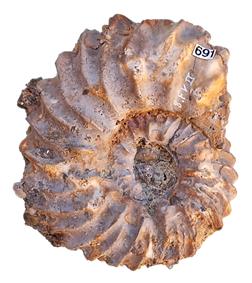
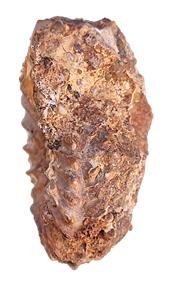
Internal mold, reworked and silicified, with a hexagonal section 50% covered at the beginning of last whorl. As is often the case in Opis gravels, only one side is well preserved. The other side and almost the entire periphery are merged in a hard sandstone with large, rounded quartz grains. The beginning of body chamber corresponds to the last two ribs, with a clear tendency to uncoil. The umbilicus, sloping at 40°, is broadly rounded towards the flank. Its edge bears 15 prominent, triangular-profiled bullae, moving to the lower third of whorl height at the end of the whorl.
Two ribs projecting forward leave each bulla. Some are detached from their bulla. The ribbing is rather irregular, as some ribs are folded forward in the upper half of the flanks. The rib terminations make a 40° angle with the siphonal line and rise sharply to form paddles (spatulae). They alternate on each side of the siphon and define a wide and deep groove, with a flared U-shaped cross-section.
Remarks.
The last table compares the Hoplites with irregularly folded ribs and ventral paddles of Spath (1925), based on his specimens. We follow Amédro (1992) and Amédro et al. (2014), who consider them variants of H. rudis. These ammonites are typical of the top of dentatus zone and the base of intermedius zone. Rib folds appear at around 2 or 3 cm in diameter: smaller specimens look identical to H. dentatus and its variants. The H/T ratio of 0.83 for our RJ-691 corresponds to the rudis and maritimus variants, but the latter is even more spiny (see its entry).
H. rudis is often confused online with thick forms of H. benettianus from bed B of Courcelles, whose primary ribs below the umbilical bullae are radial, while the secondary ribs that bifurcate from the bullae are very proverse. H. rudis does not extend down to bed B, its ribs are folded higher on the flanks, and it has a wider ventral groove.