Created 2023/04/17
Updated 2024/10/12
Hoplites (Hoplites) pseudodeluci Spath, 1925
| Measurements |
D mm | H/D | T/D | O/D | H/T |
|---|
| Spath 1925 | 34 | 0.46 | 0.46 | 0.24 | 1.00 |
| CP-623 | 165 | 0.41 | 0.37 | 0.32 | 1.08 |
| CP-687 figuré
| 193 | 0.38 | 0.45 | 0.32 | 0.85 |
| Age |
Origin |
|---|
Sables de Frécambault, benettianus zone
lyelli subzone, base of Middle Albian
|
Yonne
France
|
| Var. | devisensis | pseudodeluci | baylei
| benettianus | bullatus |
|---|
| H/T | 1.27-1.37 | 0.90-1.08 | 0.76-0.80 | 0.64-0.66 | 0.55-0.59 |
| T/D | 0.32-0.37 | 0.39-0.46 | 0.53-0.54 | 0.63-0.69 | 0.66-0.73 |
Description.
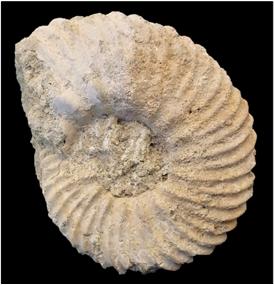
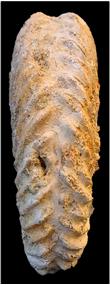
Read first the entry for Hoplites benettianus. Large internal mold in coarse sandstone with a largely preserved beige test. The aperture is not prepared. Whorls half-covered. Umbilicus sloping at 60° with a broadly rounded edge. Section somewhat compressed, trapezoidal, with slightly convex flanks, more curved near venter. Seventeen elongated, slightly proverse tubercles rise progressively on the umbilical wall. They reach their maximum height shortly after the umbilical margin and give rise to pairs of forward-curving ribs. The rib terminations reach the siphonal line at 45°. They alternate on either side of this line and define a narrow, V-shaped sulcus. Including a few shorter intercalaries, there are 40 fine, dense ribs at the top of the flanks.
Remarks.
Personal discovery. The last table compares, by increasing thickness, five V-shaped Hoplites with a ventral groove described in Spath (1925), based on measurements of his specimens. These ammonites are now considered variants of H. (H.) benettianus (J. de C. Sowerby, 1826), which has anteriority (Amédro 1992; Courville & Lebrun, 2010; Amédro et al., 2014). Our specimen corresponds to the pseudodeluci variant according to its H/T ratio, but to the devisensis variant if we consider its T/D. This clearly shows that H. (H.) benettianus is a highly variable species, with many possible intermediates.
The preservation is typical of the "Sables de Frécambault" formation: reworked ammonite, internal mold in coarse sandstone, fragile test and perforated umbilicus obstructed by sandstone. The V-shaped groove is indistinct due to the whitish test of our specimen, but a slight interlocking of the ribs is clearly visible at the bottom of ventral view. A trick to distinguish H. (H.) benettianus and its variants from H. (H.) dentatus and its variants is to follow the siphonal line with a pencil: if the tip zigzags, as here, you have a benettianus.