| Measurements | D mm | H/D | T/D | O/D | H/T |
|---|---|---|---|---|---|
| CP-437 | 86.2 | 0.47 | 0.66 | 0.25 | 0.71 |
| Age | Origin |
|---|---|
|
Bed B, benettianus zone lyelli subzone, Middle Albian |
Courcelles, Clérey Aube, France |
| Measurements | D mm | H/D | T/D | O/D | H/T |
|---|---|---|---|---|---|
| CP-437 | 86.2 | 0.47 | 0.66 | 0.25 | 0.71 |
| Age | Origin |
|---|---|
|
Bed B, benettianus zone lyelli subzone, Middle Albian |
Courcelles, Clérey Aube, France |
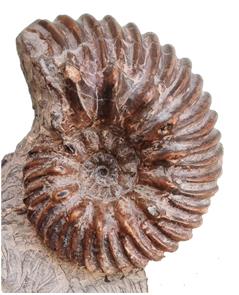
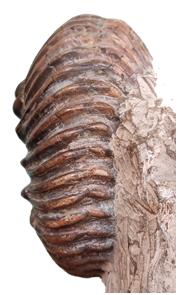
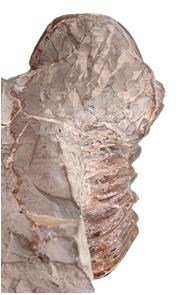
Description. Ammonite with the typical preservation of Courcelles bed B: brown shell and gray limestone matrix serving as a base. The whorls, 60% covered, have a hexagonal section with broadly rounded ventrolateral shoulders. The funnel-shaped umbilicus, sloping at 45°, clearly shows the inner whorls. Primary ribs originate at the umbilicus suture, forming prominent triangular bullae at the umbilical margin, and divide into two rounded ribs curved forward. Most of these pairs are separated by untuberculate intercalaries. All ribs are similar at the top of the flanks. They are prominent, narrow, with slightly larger spaces between them. They cross the venter, forming a broad, rounded forward sinus. They slightly sag as they cross the siphonal line. The ribs on the right flank are slightly offset anteriorly. In total, there are 13 umbilical bullae and 34 ribs on venter.
Remarques. The forked ribs crossing venter might suggest a Hoplites (Isohoplites) or a Sonneratia, but these are only found in the Lower Albian. In fact, the presence in bed B at Courcelles (early Middle Albian) and the profile view with high-positioned umbilical bullae, probably corresponds to a thick Hoplites (Hoplites) benettianus, or possibly a H. (H.) dentatus, which already exists in this layer. The specimen is pathological because its ribs, normally interrupted on venter and with alternate terminations, have fused with those on the opposite flank. As the two species differ in their ventral sulcus, absent here, it is not possible to decide. Such pathological specimens are not uncommon at Courcelles. Sometimes, shell deformity follow a predator bite, but there is no evidence of this here.