Created 2023/08/08
Updated 2024/10/12
Hoplites (Hoplites) dorsetensis Spath, 1925
| Measurements |
D mm | H/D | T/D | O/D | H/T |
|---|
| CP-350 | 41.5 | 0.47 | 0.32 | 0.25 | 1.48 |
| Holotype | 150 | 0.44 | 0.34 | 0.25 | 1.29 |
| Age |
Origin |
|---|
Top of dentatus zone
Grey clay, Middle Albian
|
Meuse
France
|
| Var. | similis | dorsetensis | canavariformis
| canavarii |
|---|
| H/T | 1.07-1.16 | 1.29 | 0.88 | 0.66 |
| T/D | 0.37-0.43 | 0.34 | 0.47 | 0.65 |
| Ribs | ≈ 50 | 38 | ≈ 35 | ≈ 32 |
Description.
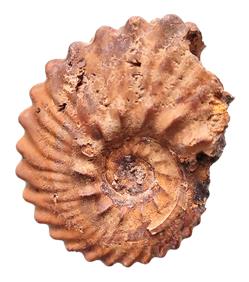
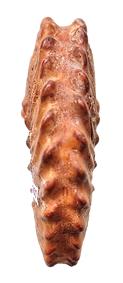
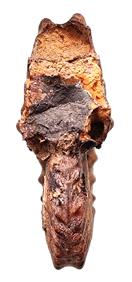
A somewhat involute, pyritic phragmocone, with whorls that are half-covered and have a compressed trapezoidal section with flat flanks. The umbilicus has a low wall with a 45° slope, rounding towards the flank. There are 15 small, proverse umbilical bullae. Each bulla gives rise to a pair of lautiform ribs, terminating in a rounded ventrolateral clavus. The rear rib of each pair is often folded forward at the outer quarter of the flanks. There are also a few simple, non-tuberculate ribs, which also terminate in a ventrolateral clavus. The clavi are alternate on either side of venter and define a concave groove. They form a 45° angle with the siphon and then tend to become parallel at the end of the whorl. There are a total of 25 clavi and about 40 ribs.
Remarks.
The last table 3 compares the lautiform-ribbed Hoplites of Spath (1925), based on his specimens, from the most delicately ornamented to the most robust: H. similis Spath, 1925; dorsetensis Spath, 1925; canavariformis Spath, 1926; and canavarii (Parona & Bonarelli, 1897). There are no clear boundaries between these forms. Amédro (1992) and Amédro et al. (2014) consider them variants of H. canavarii, which was defined first.
Given its number of ribs and H/T ratio, CP-350 is the dorsetensis variant; compare with Spath, 1925, pl. IX, fig. 1a-b. The similis variant is not the most compressed but is distinguished by its numerous fine ribs (Spath, p. 111). Our ammonite resembles the older Otohoplites subhilli and the more recent Dimorphoplites chloris (see their entries), but it has a distinct ventral groove. It has been found with H. dentatus, rudis, and latesulcatus, indicating the upper part of the dentatus zone. Forms with only a few lautiform ribs, still close to H. rudis, are found in the same layer.