Created 2024/10/03
Updated 2025/10/02
Hoplites (Hoplites) devisensis Spath, 1925
| Measurements |
D mm | H/D | T/D | O/D | H/T |
|---|
| Holotype | 30 | 0.47 | 0.37 | 0.27 | 1.27 |
| Jaffré 2007 p.65 | 65.3 | 0.41 | 0.32 | 0.29 | 1.27 |
| RJ-1265 | 75.8 | 0.46 | 0.38 | 0.30 | 1.20 |
| Age |
Origin |
|---|
Nodule from bed B, lyelli subzone
benettianus zone, Middle Albian
|
Brévonnes
Aube, France
|
| Var. | devisensis | pseudodeluci | baylei
| benettianus | bullatus |
|---|
| H/T | 1.27-1.37 | 0.90-1.08 | 0.76-0.80 | 0.64-0.66 | 0.55-0.59 |
| T/D | 0.32-0.37 | 0.39-0.46 | 0.53-0.54 | 0.63-0.69 | 0.66-0.73 |
Description.
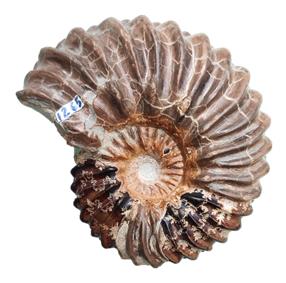
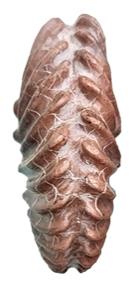
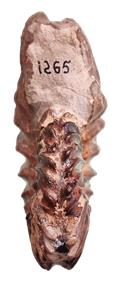
First, read the entry for Hoplites benettianus. Compressed ammonite with whorls 40% covered, a pyritic nucleus with visible sutures and a limestone body chamber with a preserved test, occupying slightly less than half a whorl. Umbilicus sloping at 45° with a well-rounded edge. The high trapezoidal section with slightly convex flanks reaches its maximum thickness at the 14 umbilical bullae. The latter originate on the umbilical wall and are initially low, located at one quarter of whorl height. They become very prominent on the body chamber and move to one third of whorl height. Each bulla gives rise to two strong, proverse ribs, curved forward. Their raised ends alternate on either side of the siphon, against which they collapse, forming a 100° chevron and delimiting a narrow V-shaped groove. Some ribs separate from their umbilical bulla and a few additional ribs are inserted, giving a total of 32 ribs near venter.
Remarks.
The last table compares, by increasing thickness, the five Hoplites with a V-shaped ventral groove described in Spath (1925), based on measurements of his specimens. These are now considered variants of H. (H.) benettianus (J. de C. Sowerby, 1826), which was first described (Amédro 1992; Courville & Lebrun, 2010; Amédro et al., 2014). RJ-1265 falls between H. devisensis and H. pseudodeluci, demonstrating the existence of intermediate forms. We assign it to the closest variant, devisensis.
A beginner might mistake RJ-1265 for a compressed Hoplites dentatus, identical in profile view. Recall the trick for distinguishing benettianus from dentatus: if you follow the siphonal line with the tip of a pencil, it will zigzag instead of moving in a straight line. With its raised costal terminations, RJ-1265 also resembles the persulcatus variant of Hoplites (H.) rudis. However, the latter is more recent (top of dentatus zone) and its ribs are irregularly folded forward in the outer third of flanks.