| Measurements | D mm | H/D | T/D | O/D | H/T |
|---|---|---|---|---|---|
| RJ-64C | 27 | 0.48 | 0.38 | 0.24 | 1.30 |
| Holotype | 72 | 0.47 | 0.37 | 0.22 | 1.27 |
| Age | Origin |
|---|---|
|
Grey clay, bed C dentatus zone Middle Albian |
Courcelles Aube France |
| Measurements | D mm | H/D | T/D | O/D | H/T |
|---|---|---|---|---|---|
| RJ-64C | 27 | 0.48 | 0.38 | 0.24 | 1.30 |
| Holotype | 72 | 0.47 | 0.37 | 0.22 | 1.27 |
| Age | Origin |
|---|---|
|
Grey clay, bed C dentatus zone Middle Albian |
Courcelles Aube France |
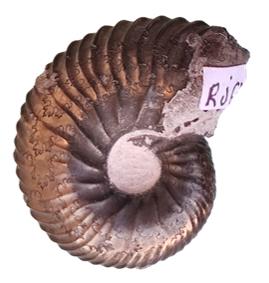
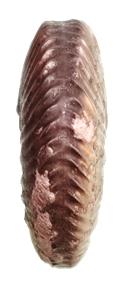
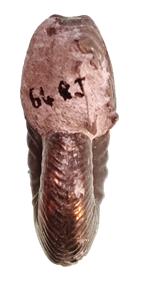
Description. This entirely septate internal mold is made of well-preserved pyrite. Its whorls with a compressed trapezoidal section overlap by 60%. The flanks are moderately convex, and the maximum thickness is located at the lower third of whorl section. The rather low umbilical wall, sloping at 45°, is flat and joined to the flank by a rounded edge. Sixteen thin, very proverse primary ribs originate at the umbilical suture, then rise without widening to form a bulla on the umbilical margin. Each bulla give rise to two, sometimes three, sigmoid ribs that terminate on the ventrolateral shoulder with a moderate elevation and form an angle of 60° to the siphonal line. The rib terminations alternate on either side of the siphon and delimit a shallow groove. Numerous intercalary ribs originate in the lower half of the flanks, resulting in a total of 51 ribs near venter. On the last half-whorl the primaries become longer and give a falcate aspect to the ribs. The clearly visible sutures are those of Hoplites dentatus.
Remarks. A variety created by Spath for specimens with about fifty ribs, whereas typical Hoplites dentatus have about forty. Spath's type (1925, pl. 7, fig. 10a-b) has ribs curved forward. Specimen RJ-64 is unusual because it has thin, sigmoid ribs. According to Francis Amédro, whom I consulted, it is a transitional form between H. dentatus and Anahoplites intermedius. Indeed, the umbilical tubercles are inclined forward, which makes the ribs sigmoid, and the ventral ends of the ribs are not very high, resulting in a shallow groove: compare with the A. intermedius in figure 36 on page 134 of Spath. However, we do have a H. dentatus because A. intermedius with its filled ventral groove does not yet exist in bed C of Courcelles.