Created 2023/03/30
Updated 2024/10/12
Hoplites (Hoplites) canavariformis Spath, 1926
| Measurements |
D mm | H/D | T/D | O/D | H/T |
|---|
| RJ-22 | 37.6 | 0.42 | 0.49 | 0.28 | 0.86 |
| Holotype | 56 | 0.41 | 0.46 | 0.27 | 0.88 |
| Age |
Origin |
|---|
Phosphatic nodules of bed E
dentatus zone, Middle Albian
|
Courcelles
Aube, France
|
| Var. | similis | dorsetensis | canavariformis
| canavarii |
|---|
| H/T | 1.07-1.16 | 1.29 | 0.88 | 0.66 |
| T/D | 0.37-0.43 | 0.34 | 0.46 | 0.65 |
| Ribs | ≈ 50 | 38 | ≈ 35 | ≈ 32 |
Description.
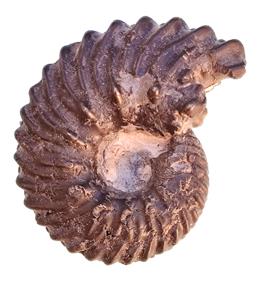
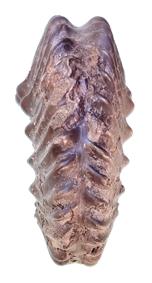
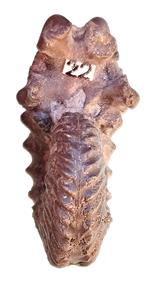
A completely septate ammonite made of black phosphate, with slightly depressed hexagonal whorls that overlap by half. The rather deep umbilicus has a 70° sloping wall that curves towards the flank. Its edge bears 13 small bullae, the last 5 very prominent, from which pairs of forward-curving ribs extend. Some are folded at the outer third of the flanks, and several pairs of lautiform ribs are observed. The raised rib terminations reach a 45° angle to the siphonal line and alternate on either side of it. They define a groove with a flared U-shaped cross-section, with a straight, smooth band at its bottom. Including some ribs detached from their umbilical bullae and a few extra, there are 34 ribs at the top of the flanks.
Remarks.
The last table compares the lautiform Hoplites of Spath (1925), based on his specimens, from the most delicately ornamented to the most robust: H. similis Spath, 1925; dorsetensis Spath, 1925; canavariformis Spath, 1926; and canavarii (Parona & Bonarelli, 1897). There is no clear boundary between these forms. Amédro (1992) and Amédro et al. (2014) consider them variants of H. canavarii, which was defined first.
Given the H/T, we assign RJ-22 to H. canavariformis, an ammonite from the upper part of dentatus zone and the base of intermedius zone. Since Spath (1926) gives no measurements of the holotype, we approximately deduced them from his photographs (pl. XVII, fig. 3). The presence of folded ribs, as in Hoplites rudis, on our specimen suggests the lineage rudis → canavarii.