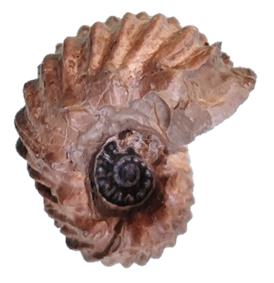
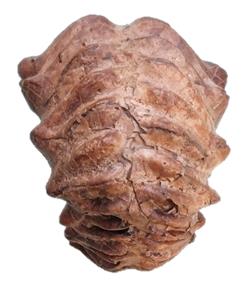
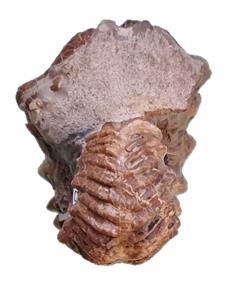
Hoplites (Hoplites) bullatus – Other specimen
| Measuremnts |
D mm | H/D | T/D | O/D | H/T |
|---|
| RJ-42 | 18 | 0.39 | 0.72 | 0.29 | 0.54 |
| CP-704 | 54.1 | 0.41 | 0.79 | 0.33 | 0.52 |
| BM 37652 Spath | 60 (50) | 0.36 | 0.66 | 0.36 | 0.55 |
| Age |
Origin |
|---|
Nodule from bed B, lyelli subzone
benettianus zone, Middle Albian
|
Courcelles
Aube, France
|
Description.
Read first the entry for Hoplites benettianus. Individual found in a nodule of bed B from Courcelles, with a brown test on an internal mold of light gray limestone. The beginning of the last half-whorl is crushed and the aperture is deformed. The whorls, 25% covered, have a very depressed hexagonal section, twice as wide as they are tall. The umbilicus is very deep, stepped, with a vertical wall passing to the flank via a narrowly rounded edge. No discernible primary ribs lead to the very prominent umbilical bullae. These bullae are slightly radially pinched knobs, each giving rise to two almost straight ribs projecting forward. All ribs stop on venter, with alternating terminations on either side of siphonal line, delimiting a narrow V-shaped sulcus. Some terminations are even slightly interlocked at the beginning of last whorl. With a few shorter intercalaries, the last whorl has 12 umbilical bullae and 28 ribs that look identical at the top of the flanks.
Remarks.
Given its narrow V-shaped ventral groove and very depressed whorl section, we can assign CP-704 to the bullatus variant of Hoplites benettianus, which has the closest H/T ratio. In such forms, the considerable thickness of the whorls mechanically elevate the umbilical wall, which raises the umbilical bullae to mid-height, and makes the section hexagonal.