Created 2023/04/19
Updated 2025/06/20
Hoplites (Hoplites) baylei Spath, 1925
| Measurements |
D mm | H/D | T/D | O/D | H/T |
|---|
| Spath 1925 | 39 | 0.43 | 0.54 | 0.27 | 0.80 |
| CP-624 | 121 | 0.39 | 0.50 | 0.29 | 0.78 |
| Jaffré 2007 p.69 | 131 | 0.42 | 0.53 | 0.31 | 0.79 |
| Age |
Origin |
|---|
Sables de Frécambault, benettianus zone
lyelli subzone, beginning of Middle Albian
|
Yonne
France
|
| Sp. | devisensis | pseudodeluci | baylei
| benettianus | bullatus |
|---|
| H/T | 1.27-1.37 | 0.90-1.08 | 0.76-0.80 | 0.64-0.66 | 0.55-0.59 |
| T/D | 0.32-0.37 | 0.39-0.46 | 0.53-0.54 | 0.63-0.69 | 0.66-0.73 |
Description.
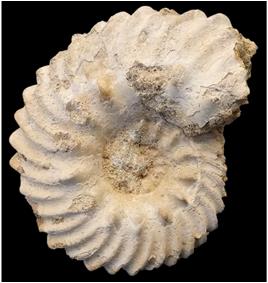
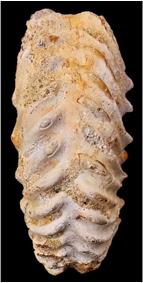
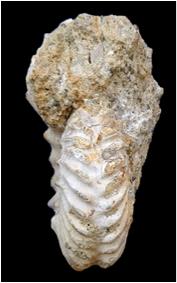
First, read the entry for Hoplites benettianus. Ammonite quite thick with its test, whorls covered by 50%, and the body chamber preserved on the last quarter of whorl. The hexagonal section has its maximum thickness at the umbilical tubercles, at 45% of whorl height. The umbilicus, sloping at 50°, has a well-rounded edge. Fourteen radially elongated umbilical bullae originate on the umbilical wall and become very prominent, before giving two strong, concave ribs projecting forward. Their terminations are slightly raised and alternate on either side of siphonal line. They form an angle of 50-55° with it and define a narrow, V-shaped groove. Including a few untuberculate intercalaries, there are 34 ribs near the venter.
Remarks.
Personal discovery. The last table compares the five V-grooved Hoplites described in Spath (1925), based on his specimens. They are now considered variants of H. benettianus (Amédro 1992; Courville & Lebrun, 2010; Amédro et al., 2014).
Our CP-624 is the "medium" variant of H. benettianus, the most common in Yonne. The V-shaped groove is barely visible on the whitish test, but we see the slight interlocking of ribs on the lower part of ventral view.
Comparison with the entry for H. pseudodeluci illustrates the changes when examining specimens of increasing thickness. The umbilical wall rises. The umbilical tubercles are located higher, which shortens the ribs and changes the whorl section from trapezoidal to hexagonal. They are also more prominent: they emerge from the flanks on the ventral view. The number of ribs decreases, but they are stronger and more proverse. Their angle of incidence to the siphon increases. The same modifications are observed in the variants of H. dentatus.