Created 2024/05/25
Updated 2024/06/07
Protohoplites (Hemisonneratia) transitorius Saveliev, 1992
| Measurements |
D mm | H/D | T/D | O/D | H/T |
|---|
| CP-427/1501 |
45.0 | 0.46 | 0.36 | 0.27 | 1.29 |
| Holotype |
49.5 | 0.43 | 0.37 | 0.26 | 1.16 |
| Age |
Origin |
|---|
O. sinzowi zone, P. (H.) puzosianus
subzone of the Mangystau
Lower Albian
|
North-Aktau Ridge
Mangystau Peninsula
Kazakhstan
|
Description.
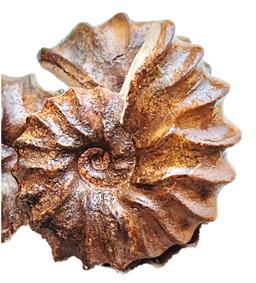
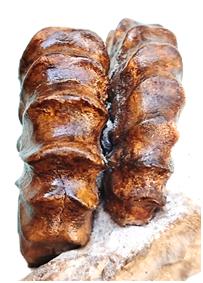
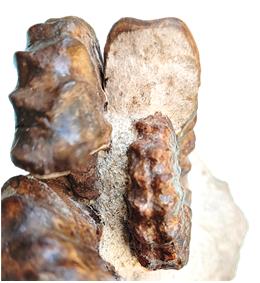
Specimen on a block of gray sandstone with two Protohoplites (Hemisonneratia) subtransitorius. It is on the left in the ventral view and on the right in the view of the aperture. The whorls overlap by half, and the body chamber occupies slightly less than half of the last whorl. The umbilical wall, short and sloping at 60° at the beginning of the last whorl, lengthens and becomes less steep (30°) thereafter, to the point that the umbilical edge and the maximum thickness rise to half the whorl height at the end of the whorl. 11 sharp, proverse bullae climb this wall and elongate with it.
Each bulla gives rise to two ribs. The anterior rib is in line with the bulla and forms with it a proverse, flexuous rib. The posterior rib is folded back and retroverse, with a bifurcation angle reaching 60° at the end of the whorl. There are a total of 20 ribs, increasingly prominent and sharp, including 2 simple ribs. They reach their maximum height on the ventral shoulders and cross the venter with a broad, rounded sinus. At the beginning of the last whorl, they show a narrow but shallow depression over the siphon, forming a sort of groove. This depression then becomes wider. Sutures indistinct.
Remarks.
This species was created by Saveliev in 1974 without a description (nomen nudum), then correctly defined in 1992. It belongs to a group of Protohoplites from the Mangystau region defined by this author: P. hemilevis, P. solaris, P. transitorius, and P. subtransitorius. These rather similar, perhaps conspecific, forms are more compressed than the P. (H.) puzosianus of the Anglo-Paris Basin. P. (H.) transitorius has a more or less compressed whorl section but is distinguished within its group by very elongated umbilical bullae, with a bifurcation of the ribs that rises rapidly to mid-height of the whorl.