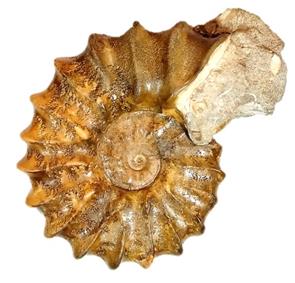
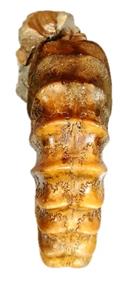
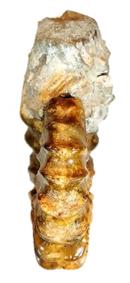
Protohoplites (Hemisonneratia) subtransitorius Saveliev, 1992
| Measurements |
D mm | H/D | T/D | O/D | H/T |
|---|
| CP-383 |
55.5 | 0.40 | 0.34 | 0.30 | 1.17 |
| 1474 Saveliev holotype |
56.2 | 0.41 | 0.39 | 0.26 | 1.05 |
| CP-447 |
59.3 (57.5) | 0.38 | 0.39 | 0.31 | 0.98 |
| CP-447 |
59.3 (48.0) | 0.39 | 0.36 | 0.29 | 1.11 |
| 1321 Saveliev |
75.0 | 0.41 | 0,37 | 0.28 | 1.11 |
| Age |
Origin |
|---|
O. sinzowi zone, P. (H.) puzosianus
subzone of the Mangystau
Lower Albian
|
North-Aktau Ridge
Mangystau Peninsula
Kazakhstan
|
Description.
Internal mold brownish-yellow, with the body chamber preserved on 1/5 of the last whorl, which overlaps the previous one by a third. Trapezoidal cross-section, slightly compressed, thickened over the body chamber. Umbilicus with a flat wall at 40°, rounding towards the flank and becoming more abrupt at the end of last whorl. 11 prominent umbilical bullae, the last ones longer, each give rise to two sharp ribs with a significant bifurcation angle. They become very tall on venter, forming a crenellation-like projection. They draw a shallow, wide, and rounded ventral sinus, and flatten out slightly above the siphon from a diameter of 40 mm. A simple tuberculate rib is intercalated between the last pairs. On the venter, there are a total of 19 widely spaced ribs, with wide and harmoniously concave interspaces.
The clearly exposed sutures show a ventral lobe that is narrow at the bottom (1/3 the width of venter) but flares out at the top. The main saddle is quite wide and incised in the middle. The first lateral lobe is as tall as the ventral lobe, with five acute teeth, the three lower ones being more developed. The other elements contract rapidly in height towards the umbilical suture.
Remarks.
Saveliev named the species in 1974 without describing it (nomen nudum). He defined it correctly in 1992 but moved it to the subgenus Protohoplites, because the ventrolateral tubercles are elevated and become conical with age. This transfer is rejected here, because the specimens in the table have ribs that are still high on the siphon, whereas they are residual or absent at these diameters in the subgenus Protohoplites (Casey, 1965). This species belongs to a group of compressed forms of the Mangystau defined by Saveliev: P. hemilevis, P. solaris, P. transitorius, and P. subtransitorius. These rather similar ammonites are perhaps conspecific. P. (H.) subtransitorius is distinguished by its few ribs (17-19 per turn), very high on venter, and a slightly compressed section.