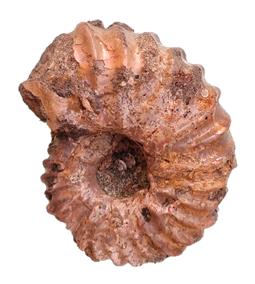
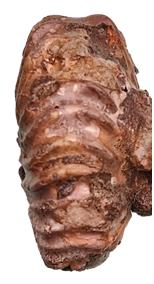
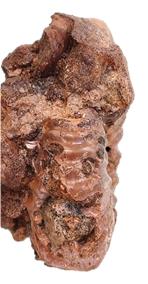
Protohoplites (Hemisonneratia) puzosianus – Other specimen
| Measurements |
D mm | H/D | T/D | O/D | H/T |
|---|
| CP-428/74 |
49.5 | 0.43 | 0.49 | 0.31 | 0.87 |
| RJ-1245 figured |
56.7 | 0.47 | 0.49 | 0.25 | 0.96 |
| GSM 30946 Casey 1965 |
80 | 0.40 | 0.44 | 0.32 | 0.91 |
| BM C72831 Casey 1965 |
87(80) | 0.42 | 0.47 | 0.31 | 0.89 |
| Lectotype Douvillé 1911 |
87 | 0.44 | 0.48 | 0.28 | 0.92 |
| Age |
Origin |
|---|
Phosphatic nodules, condensed level
S. kitchini to P.(H.) puzosianus zones
Lower Albian
|
Machéroménil
Ardennes
France
|
Description.
Reworked nodule of black phosphate with a coppery test, not prepared on the right in the ventral view: these fragile nodules resemble old lumps of agglomerated coal and can burst under a pneumatic hammer. The internal whorls are missing.
Whorls as tall as they are wide, 40% covered, with a body chamber on half a whorl. At the beginning of the last whorl (43 mm), the hexagonal section is that of Sonneratia dutempleana. The deep umbilicus has a vertical wall rounded towards the flank. The small, prominent umbilical bullae give rise to two proverse, arched ribs, crossing the venter without collapsing, forming a broad sinus.
Despite chipped ribs, a flattening of the ribs on the ventral side is noticeable starting at 50 mm, three-quarters of a turn before the aperture. This is clearly visible at the top of the ventral view. The venter and the flanks flatten even further. The umbilical wall becomes less steep. The ribs are more spaced out, less curved, with their maximum height on the ventrolateral shoulders. Towards the end, they are almost straight and lose their ventral sinus; the umbilical bullae elongate, and one rib of each pair detaches. There are a total of 15 bullae and 28 ribs on the last turn.
Remarques.
Identification confirmed by Francis Amédro. This specimen is not as well preserved as CP-428/74 (see its entry). It has a longer Sonneratia stage, less thickness, more ribs, and a narrower umbilicus, demonstrating the variability of the species. Protohoplites (Hemisonneratia) gallicus (see its entry) also has a late rib collapse on the venter, but its whorl section is more depressed.