Created 2023/03/07
Updated 2024/01/11
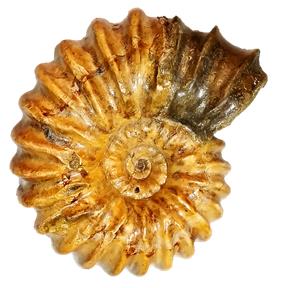
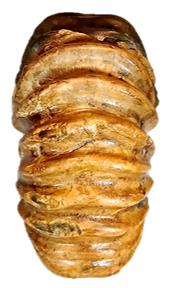
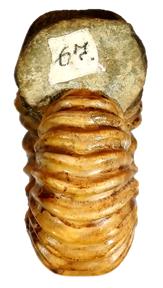
Protohoplites (Hemisonneratia) gallicus (Breistroffer, 1947)
| Measurements |
D mm | H/D | T/D | O/D | H/T |
|---|
| CP-422/175 |
43.5 | 0.40 | 0.57 | 0.30 | 0.71 |
| CP-362 |
60 | 0.45 | 0.54 | 0.29 | 0.83 |
| CP-379 |
61.2 | 0.38 | 0.49 | 0.31 | 0.78 |
| Holotype Jacob 1907 |
80 | 0,38 | 0.48 | 0.34 | 0.79 |
| Age |
Origin |
|---|
Mangystau: sinzowi zone, puzosianus
subzone. France, England: puzosianus
zone. Lower Albian
|
North-Aktau Ridge
Mangystau Peninsula
Kazakhstan
|
Description.
A thick, somewhat evolute specimen (whorls overlap by 35%), with a deep umbilicus extending over one-third of diameter. The umbilical wall, initially vertical, slopes to 45° at the end of the whorl. The test is preserved, except for the last eighth of the whorl which reveals part of the body chamber, compressed vertically. The whorl section is depressed hexagonal, with nearly flat flanks and no trace of concavity. Fifteen very prominent umbilical bullae reach their maximum height on the umbilical margin and give rise to bifurcated, radial, slightly arched ribs that cross venter with a weak, broad sinus. There are 23 ventral ribs, 5 of which are isolated, tuberculate or not. The intercostal space is wider than the ribs. The ribs are sharp beneath the test but have rounded crests where they are covered. A slight siphonal depression of the ribs appears at the beginning of the last half-whorl, around 47 mm. However, the ribs appear more sagged because the belly remains slightly convex between the ribs.
Remarks.
Species created by Breistroffer (1947, p. 85) under the name Arcthoplites subquadratus (Sinzow) var. gallica, for the Parahoplites puzosianus of fig. 9, pl. 8 of Jacob (1907), to which our specimen closely resembles. Matrion et al. (2000) considers it a variant of P. (H.) puzosianus (see its entry). But according to Casey (1965), it resembles Sonneratia dutempleana for a longer stage (up to 40 mm), with lower whorls and a later ventral depression. In addition, Casey's specimens have a wider umbilicus and more numerous ribs. In our opinion, the juvenile before 30 mm is still distinguishable from S. dutempleana by a semi-circular section (ventro-lateral shoulders are not yet visible), less proverse ribs and a weaker ventral sinus.