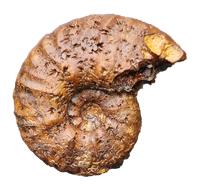
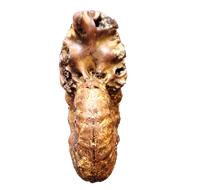
Description. The type species is Desmoceras clansayense Jacob, 1905. According to Casey (1949) and Wright (1996), Uhligella includes moderately involute discoid shells with a compressed elliptical whorl section, thickest near the umbilical margin. Shallow and irregular constrictions are characteristic. The inner whorls have sinuous, rounded, strong or weak main ribs, with umbilical bullae and intercalary ribs. With growth, the ornamentation gradually faints and whorls become smooth. There is considerable variation in the strength and persistence of this ornamentation. In U. rebouli (Jacob), for example, the ribs are relatively reduced and only the insignificant umbilical bullae distinguish it from weakly ribbed species of Beudanticeras. At the other extreme, U. balmensis (Jacob) has tuberculate inner whorls with distinct ribs, reminiscent of Cleoniceras or Sonneratia. According to Riccardi & Medina (2002), this genus existed from the Late Aptian to the Middle Albian: Europe, North Africa, Argentina, Colombia, Mexico, Venezuela, and the USA (Arkansas).
Species. One can cite U. balmensis Jacob (photos on the left), U. boussaci Fallot, U. clansayensis Jacob, U. derancei Casey, U. rebouli Jacob, and U. subonata Casey. Many species have been defined based on small pyritic specimens, using minor differences in section shape and thickness, the strength of ornamentation, and the number of ribs and constrictions. Furthermore, even within the same species, the smooth stage is reached more or less quickly. Therefore, it is likely that some forms are conspecific.
Remarks. Genus known in southeastern France, but rare in the Anglo-Paris Basin. Originally, Jacob included species without umbilical bullae, such as U. zuercheri from the Aptian, which later gave rise to genus Zuercherella, and U. walleranti from the Lower Albian, now assigned to Beudanticeras. It was Breistroffer (1947) who restricted the genus to tuberculate forms. In 2001, Robert et al. already wanted to limit Beudanticeras to the flatest and sparsely ornamented forms (B. beudanti, laevigatum, newtoni, revoili), and transfer the thicker forms with ribs and constrictions (such as B. dupinianum) into Uhligella, although they do not have umbilical tubercles.
Latil et al. (2023) propose a different restructuring. They retain in Beudanticeras only the discoid forms from the Upper Albian, without constrictions but with a deeply incised suture, and a first lateral lobe (L1) bifid and strongly asymmetrical. They create a new genus Roberticeras for the other forms from the Lower Albian and the base of the Middle Albian, characterized by a trifid, symmetrical or slightly asymmetrical L1, and the presence of constrictions at some stage in the ontogeny.