Description. Type Ammonites placenta DeKay, 1828. According to Klinger & Kennedy (1989), this involute and compressed genus is very variable. The juvenile is very compressed, high-whorled, with a small crateriform umbilicus, flat and smooth flanks, and a smooth ventral band with angular shoulders. The adolescent develops umbilical tubercles, ventral clavi, and falcate ribs. In the adult, the ventral clavi disappear, the venter becomes rounded, the umbilicus flares, and the umbilical tubercles may move to mid-flank. The suture line is little incised, with low elements including bifid saddles. The first three lateral lobes form a rursiradiate alignment, while the next ones are radially arranged or slightly offset forward. Cosmopolitan genus from Upper Albian to Lower Campanian, Europe, eastern Africa, Israel, Madagascar, centra Asia, southern India, British Colombia, USA, Mexico, Colombia.
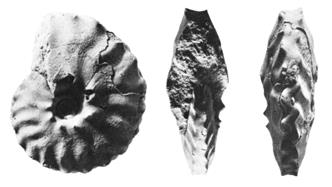
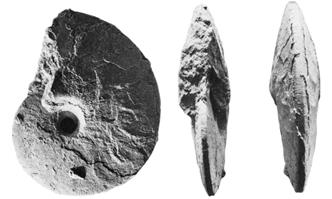
Variability also arises from the fact that individuals progress more or less quickly through the growth stages. The photographs on the left show two Placenticeras kaffrarium Etheridge, 1904, from Klinger & Kennedy (1989): they both have a diameter of approximately 7 cm, but the upper one is already in the tuberculate adolescent stage, while the lower one is still in the juvenile stage. The genus is also known for its marked sexual dimorphism. Microconchs develop strong ornamentation very early, while macroconchs, which reach a larger size, remain smooth longer and are less ornamented in adulthood.
Remarks. In the 1960s, Russian authors created closely related genera (Gissarites, Karamaites, Turkmenites, etc.) based on differences in suture lines. In 1983, Kennedy & Wright accepted the genus Karamaites, as described by Sokolov in Casey (1965), because it characterizes early forms from Albian and Cenomanian, with still subtle sexual dimorphism and a distinctive suture line: the fourth lateral lobe is smaller than the fifth. However, in a 1989 revision, Klinger & Kennedy reassigned all these genera to Placenticeras. This results in a remarkably long-lived Cretaceous genus, much like the genus Puzosia. Genera in the related family Engonoceratidae such as Knemiceras or Platiknemiceras are very similar with their narrow, flat venter, but they are distinguished by a suture line with entire saddles (not incised).