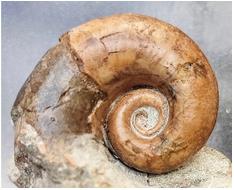
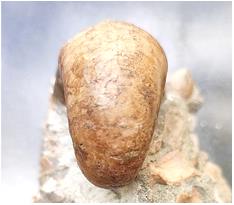
Description. The type species is Crioceras astierianum d'Orbigny, 1842. This genus is listed but without a diagnosis in Wright's Treatise (1996), as its family, Lytoceratidae, consists mainly of Jurassic species. It is described, for example, in Spath (1923), Casey (1960), and Hoffmann et al. (2009). It designates feebly ornamented Lytoceratids with disjoint whorls forming a regular spiral, as in Crioceratites. The whorls increase rapidly in width and height; they vary from subcircular, without an impression zone, to depressed reniform, sometimes with a shallow dorsal concavity. Ornamentation consists of fine ribs or simple lirae, and the internal mold is usually smooth. This rare, cosmopolitan genus existed from the Late Aptian to the base of the Middle Albian. Distribution: England, Austria, France, Switzerland, South Africa, Antarctica, Argentina, Japan, Kazakhstan (Mangystau), Madagascar, USA. The genus has three main species.
The photographs illustrate Pictetia depressa (Pictet & Campiche, 1861), with a depressed, kidney-shaped cross-section, known in the Lower Albian from the tardefurcata to the puzosianus zone. Collignon (1962) also reports it in the Upper Aptian of Madagascar, but without a more precise level. Pictetia asteriana (d'Orbigny, 1841), with a subcircular cross-section, is more recent (benettianus zone). Finally, Pictetia ovalis Collignon, 1963, has a compressed elliptical whorl section and rursiradiate ribs at the top of its flanks. It appears to be limited to Madagascar, Argentina, and the Antarctic Peninsula (Medina & Riccardi, 2014). Collignon's specimen comes from the lyelli zone of its zonation for Madagascar.
These species are therefore easy to distinguish if one can evaluate the shape of the section and the coiling. Specimens are illustrated in Pictet & Campiche (1861), Spath (1923), Casey (1960), Kennedy & Klinger (1978), Colleté (2010), and Hoffman et al. (2009, 2013), but generally without the cross-section. Curved fragments of other heteromorphic ammonites can mimic Pictetia, such as Crioceras pictetiaeforme Karakasch, 1907 (Hoffmann, 2009).
Remarks. By analyzing the sutures, Hoffmann et al. (2009) challenged the classification within the Lytoceratidae. For example, Pictetia has a trifid dorsal lobe, whereas it is bifid in Cretaceous Lytoceratids. They therefore proposed transferring the genus to the suborder Ancyloceratina, which gathers lineages of heteromorphic ammonites, but without a more precise classification. In 2013, Hoffmann et al. finally placed Pictetia in the superfamily Turrilitaceae, subfamily Hamitidae. This view was subsequently adopted by Medina and Riccardi (2014). It should be noted that Pictetia also designates a genus of plants in the family Fabaceae!