Description. Type Ammonites melchioris Tietze, 1872. According to Wright (1996) and Bogdanova et al. (2004), ammonites with a round, oval, or subrectangular whorl section. Broad venter with indistinct shoulders. The whorls increase rather slowly in height. The more or less open umbilicus has a broadly rounded margin. After a smooth stage up to 15–20 mm, 6–10 constrictions appear per whorl, straight, concave, or sigmoid, radial or proverse. Weak ribs of the same course appear later on outer half of flanks and on venter. Ribs and constrictions are projected forward near venter, and form a proverse sinus over the siphon. The suture line auxiliary elements are not retracted or just slightly retracted. Upper Barremian to Lower Albian, Europe, North Africa, Madagascar, California.
A few species. About ten species have been defined, based on the shape of the whorls, their overlap, the width of the umbilicus, the number of constrictions, and their shape. The problem is that these characteristics can change during growth stages, which, moreover, can be traversed more or less rapidly within the same species. For example, Melchiorites inornatus (d'Orbigny, 1841) was defined on smooth specimens of 15 to 25 mm, but most Melchiorites of this size are smooth! This species therefore probably corresponds to the juvenile whorls of another Melchiorites (Fischer, 2006). Let us mention just three other taxa.
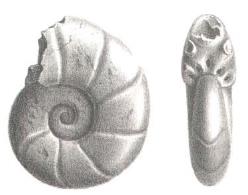
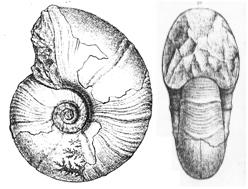
Melchiorites melchioris (Tietze, 1872) from the Barremian. The 48 mm holotype has a compressed ovoid section, a whorl overlap of less than 50%, seven proverse and concave constrictions, and an acute sinus on venter (top figure). On its now closed website, the GPA laboratory exhibited a different specimen of 130 mm, with a wider venter, 10 slightly sinuous radial constrictions, and a weaker ventral sinus. M. falcistriatus (Anthula, 1899) is known from Aptian to Lower Albian. The 92 mm holotype has a thicker oval section, whorls two-thirds covered, a smaller umbilicus with a vertical wall, somewhat sigmoid constrictions, and a broadened ventral sinus (bottom figure). According to Dutour (2005), the Aptian species M. emerici (Raspail, 1831) is also thicker than M. melchioris and bears sinuous and broad constrictions, with an anterior slope steeper than the posterior one. In fact, in the literature, we often see this asymmetry in photographs of other species.
Remarks. The thicker forms can be confused with Desmoceras latidorsatum. However, the latter, restricted to the Albian, is very involute, with an inverted U-shaped cross-section, a very broad venter, parallel flanks, and a vertical umbilical wall with a narrow edge (see its entry). Some adults have no constrictions. Melchiorites always displays constrictions, and its flanks are more or less convergent towards the venter.