Created 2023/08/16
Updated 2025/03/15
Eodouvilleiceras aff. pedrocarvajali Etayo-Serna, 1979
| Measurements |
D mm | H/D | T/D | O/D | H/T |
|---|
| Holotype | 50 | 0.36 | 0.44 | 0.39 | 0.82 |
| Casey (1962) | 59 | 0.41 | 0.54 | 0.37 | 0.75 |
| CP-177* | 90 | 0.41 | 0.53 | 0.37 | 0.77 |
* Measures including the tubercles
| Age |
Origin |
|---|
Aioloceras besairiei
Malagasy zone
Lower Albian
|
Ambatolafia, Boeny Region
Mahajanga Province
Madagascar
|
Description.
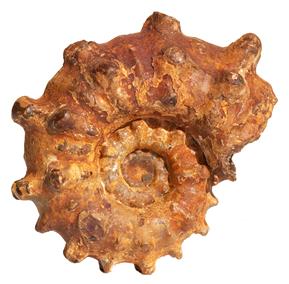
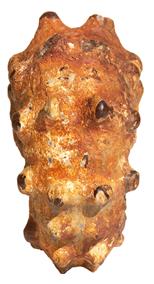
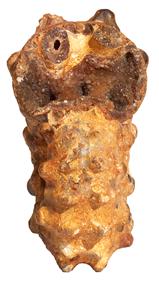
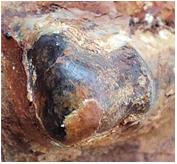
Silicified internal mold with a ferruginous coating, without visible sutures. Whorls covered to one-third, with a depressed reniform section between the ribs, but hexagonal at their level. Umbilicus stepped, wide and deep, with a vertical wall and rounded edge. 18 ribs alternately strong and weak. The strong have a small umbilical tubercle, a pimple-like lateral tubercle pressed against the umbilical wall of next whorl, and a prominent ventrolateral tubercle. They sag between the ventrolateral tubercles. On the last half-whorl, the inner side of ventrolateral tubercles shows a clavus announcing a division in two (photo on the right, the venter is on the left and the aperture at the top). The weak ribs are initially slightly lower than the strong ones and lack umbilical tubercles. At the beginning of the last half-whorl, they reduce to thin, unornamented ribs.
Remarks.
CP-177 closely resembles the Aptian Eodouvilleiceras horridum figured by Casey (1962, p. 291), in fact, an E. pedrocarvajali from the Lower Albian of Colombia according to Etayo-Serna (1979).
However, Collignon does not mention the Aptian-Albian genus Eodouvilleiceras in his Atlas. Our specimen likely comes from Ambatolafia, where locals collect pearly ammonites from a bed of green sandstone in the besairiei zone (Lower Albian). An Aptian age cannot be ruled out, as identical Aptian sandstones outcrop a few meters lower and also 20 km away at Befamonto (Besairie, 1971). We therefore classify our specimen conditionally as a species close to E. pedrocarvajali, Lower Albian.