Created 2023/10/01
Updated 2024/10/14
Dipoloceras bouchardianum (d'Orbigny, 1841)
| Measurements |
D mm | H/D | T/D | O/D | H/T |
|---|
| Lectotype |
40 | 0.41 | 0.45 | 0.32 | 0.89 |
| Holotype |
50 | 0.44 | 0.34 | 0.32 | 1.29 |
| CP-559 |
57.2 | 0.40 | 0.36 | 0.36 | 1.10 |
| Spath 1931 |
80 | 0.40 | 0.30 | 0.35 | 1.33 |
| Age |
Origin |
|---|
Phosphatic-glauconitic sand
cristatum to inflatum zones
Upper Albian condensed level
|
Disused phosphate mine
Valserhône (ex-Bellegarde)
Ain, France
|
Description.
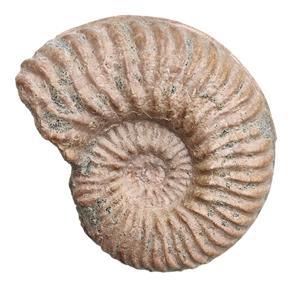
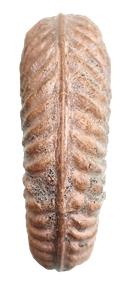
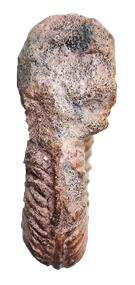
A flat ammonite in glauconitic sandstone, with its beige phosphate test, without visible sutures. Whorls 20% covered, with a subrectangular section, rounded ventrolateral shoulders, and a flattened venter. Umbilicus with a straight, high wall, sloping at 80° and rounding towards the slightly convex flank. The ribs that originate at the suture of umbilicus are proverse on its wall. They become radial on its edge and form a small, protruding bulla. Immediately after, they divide into two sigmoid ribs that gradually strengthen and project forward onto the ventrolateral shoulder, before abutting a low, thin, but sharp siphonal carina, forming a 130° chevron on either side. Some ribs detach from their umbilical bulla. There are a total of 42 ribs on venter.
Remarks.
Species with a highly variable thickness (see table). It is found alongside Dipoloceras cristatum in the zone of the same name, which marks the beginning of Upper Albian. Amédro (2009) reports it in level P5 at Wissant, and Kennedy & Delamette (1994) at Bellegarde, in the Ain department. According to Gale et al. (2011), at the Col de Palluel near Rosans (Hautes-Alpes), it appears before D. cristatum, in the Dimorphoplites biplicatus zone.
D. bouchardianum differs from D. cristatum by its more numerous and thinner ribs, without hypertrophies, and a venter not grooved along the keel. It is often confused with Oxytropidoceras (O.) roissyanum (d'Orbigny, 1841), but the latter has a lanceolate section and its less often bifurcated ribs lack umbilical bullae. Furthermore, its carina is higher, its umbilical wall less steep, and its sutures different, with a main saddle very oblique on the external side. Finally, it is found lower, at the Lower-Middle Albian boundary (steinmanni and benettianus zones).