| Measurements | D mm | H/D | T/D | O/D | H/T |
|---|---|---|---|---|---|
| CP-610 | 41.9 | 0.46 | 0.56 | 0.20 | 0.82 |
| Age | Origin |
|---|---|
|
Lower Albian Malagasy zone of Lemuroceras spathi & Brancoceras besairiei |
Ambarimaninga Boeny Region Madagascar |
| Measurements | D mm | H/D | T/D | O/D | H/T |
|---|---|---|---|---|---|
| CP-610 | 41.9 | 0.46 | 0.56 | 0.20 | 0.82 |
| Age | Origin |
|---|---|
|
Lower Albian Malagasy zone of Lemuroceras spathi & Brancoceras besairiei |
Ambarimaninga Boeny Region Madagascar |
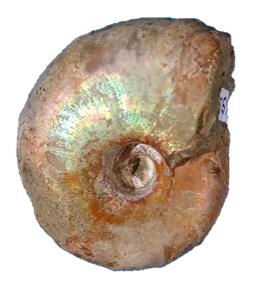
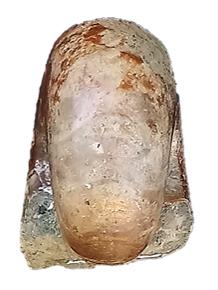
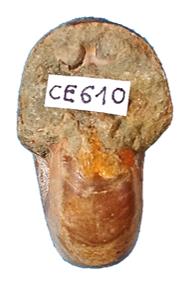
Description. Compare with the entry for D. latidorsatum sensu stricto. The ventral view was taken at the beginning of last whorl to better show the fine ridges on the shell. Small ammonite with a well-preserved, pearly test, entirely septate, very involute, with a very thick whorl section, almost semicircular but with discreet ventrolateral shoulders. Umbilicus very narrow, deep, with a vertical wall connected to the flank by a very narrowly rounded edge. The test of the last whorl shows 9 fine ridges on the outer half of flanks. They cross venter while forming a broad rounded sinus. Fine and dense sigmoid growth lines cover the test between the ridges. Unlike the ridges themselves, these lines are visible along the entire height of the flanks.
Remarks. The test hides the constrictions of the internal mold, normally located under the ridges. With its H/T ratio of 0.82, this depressed specimen corresponds to the variant inflatum Breistroffer, 1941, of D. latidorsatum. This variant, defined by its H/T ratio between 0.80 and 0.90, represents only 1% of specimens in Madagascar (Collignon, 1949). The variant obesum Reynès, 1925 is the thickest (H/T ≤ 0.80) but is even rarer. Cooper and Kennedy (1979) defined a perinflatum variant from the Angolan Albian, with an H/T ratio between 0.70 and 0.90. It therefore corresponds to the inflatum and obesum variants. Their (dubious) justification is that the new variety characterizes a population composed exclusively of thick individuals, in a specific level of the late Albian (the Stoliczkaia dispar zone).