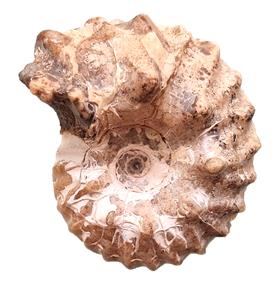
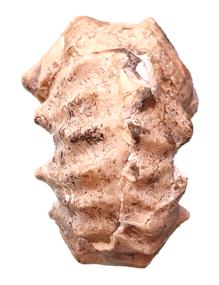
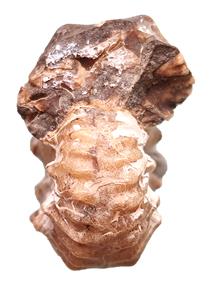
Pleurohoplites (Arraphoceras) subtetragonum Spath, 1928
| Measurements |
D mm | H/D | T/D | O/D | H/T |
|---|
| CP-407 |
30.8 | 0.44 | 0.69 | 0.28 | 0.63 |
| KY3929c* |
33.7 | 0.48 | 0.59 | 0.27 | 0.80 |
| KY3827* |
42 | 0.49 | 0.67 | 0.28 | 0.73 |
* Specimens from Kolbay in Kennedy et al. (2008)
| Age |
Origin |
|---|
Sandy clay
M. perinflatum zone
Upper Upper Albian
|
Kolbay Promontory
East of Mangystau
Kazakhstan
|
Description.
Phragmocone in beige calcite with remnants of white test, found in a calcareous nodule. The depressed whorls, 70% covered, have a distinctly hexagonal section. The funnel-shaped umbilicus has a slightly convex wall, with a 60° slope at the base. Its edge bears nine increasingly prominent bullae, even spiny close to the aperture, which give rise to two, sometimes three, straight ribs. Including a few intercalary ribs, there are 23 ribs in total.
They bear elongated ventrolateral bullae and then sag near the siphonal line. These bullae are indistinct at the beginning of the last whorl but quickly strengthen, but they do not become as prominent as the umbilical bullae. Sometimes, two ribs from two successive umbilical tubercles end at the same ventrolateral tubercle, forming zigzags on the flanks, as in Otohoplites raulinianus (see its entry). The rib terminations alternate on either side of the siphon and are loosely connected in a zigzag pattern on venter. The suture lines are invisible.
Remarks.
Spath created this species for the specimen of Ammonites raulinianus illustrated in plate 29, figure 5 of Pictet & Campiche (1860). The confusion with Otohoplites raulinianus from the Lower Albian arises from the few zigzag ribs. The name chosen by Spath comes from the resemblance to Callihoplites tetragonus. It is the only Arraphoceras cited in the article by Kennedy, King, and Ward (2008) on the Albian of Kolbay in Kazakhstan. Before this publication, the species was known only in Switzerland. Our specimen closely resembles specimen KY3827 in their plate 1, figs. 20–22.