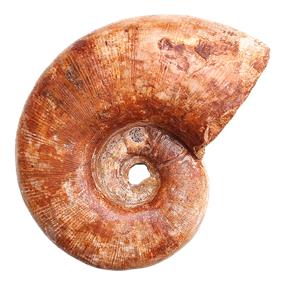
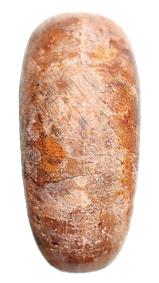
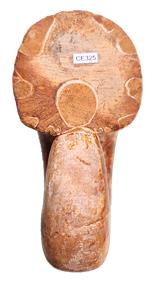
Argonauticeras besairiei Collignon, 1949
| Measurements |
D mm | H/D | T/D | O/D | H/T |
|---|
| Collignon 1949 | 43 | 0.42 | 0.49 | 0.37 | 0.86 |
| Collignon 1950a | 103 | 0.47 | 0.50 | 0.27 | 0.94 |
| CP-325 | 124.7 | 0.43 | 0.46 | 0.31 | 0.94 |
| Collignon 1962 | 200 | 0.47 | 0.53 | 0.32 | 0.89 |
| Age |
Origin |
|---|
Lower Albian
D. inaequinodum
Malagasy zone
|
Befamonto
Boeny Region
Madagascar
|
Description.
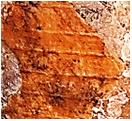
This is a very evolute phragmocone with an almost complete test but a perforated umbilicus. The whorls have a slightly depressed subrectangular section, a slight overlap, rounded ventrolateral shoulders and a narrow concave contact band on dorsum. They increase very rapidly in height (H/h = 2.63). The venter rounds towards the aperture but still exhibits indistinct shoulders. The umbilical wall is very high, subvertical, broadly rounded at the top towards the flank. The test is ornamented with hard to count lirae (at least 200), apparently very close together in profile view, but in fact with much wider interspaces under magnification, see the picture on the right. These lirae are radial or slightly proverse and cross the venter in a straight line. The penultimate whorl shows eight narrow and irregularly spaced constrictions, following the same course as the ribs, which then disappear. A few small areas that have lost their test reveal only a very asymmetrical trifid L1.
Remarks.
Collignon found a small specimen in the Lower Albian of Ambarimaninga (1949), then larger specimens in the Middle Albian of Komihevitra (1950a) and in the Late Aptian of Manera (1962). The largest specimen (270 mm), is not yet chambered. With age, whorl section becomes more rounded, the H/D ratio increases, and the O/D ratio decreases (Collignon, 1950a, 1962).
Kennedy & Klinger (1978) suggest that A. besairiei could be a synonym of A. depereti (see the genus entry), but retain the species name. It is the only Argonauticeras found in the Albian. Furthermore, the other species have distinctly proverse lirae and a slightly more open umbilicus (0.34–0.40 vs. 0.27–0.37 for A. besairiei).
A beautiful pearly Malagasy specimen from the same area is shown in Klug & Hoffmann (2015).