Anahoplites rossicus (Sinzow, 1910)
| Measurements |
D mm | H/D | E/D | U/D | H/E |
|---|
| RJ-1650 |
62 (58.3) | 0.45 | 0.25 | 0.25 | 1.82 |
| CP-430 |
73.8 | 0.45 | 0.24 | 0.23 | 1.85 |
| Kennedy & Walaszczik |
80.1 | 0.43 | 0.24 | 0.26 | 1.81 |
| Age |
Origin |
|---|
A. rossicus zone of Mangystau.
Corresponding to D. biplicatus
zone in the Anglo-Paris Basin
Upper Middle Albian
|
Koksyrtau Hill
North-Atau Ridge
Mangystau Peninsula
Kazakhstan
|
Description.
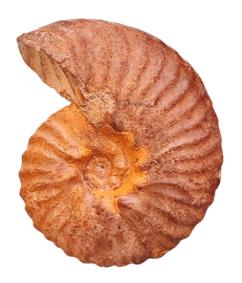
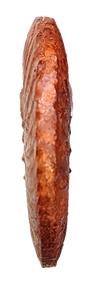
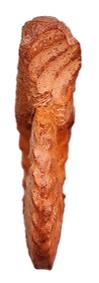
 A flat ammonite with whorls two-thirds covered and its body chamber over 200°. The umbilicus has a straight wall at 50°. Its rounded edge bears 11 bullae, each giving a pair of ribs ending in a ventrolateral clavus. With a shorter intercalary between the pairs, there are 36 ribs.
At the beginning of last whorl, the section is compressed trapezoidal with slightly convergent flanks and a flat venter. The umbilical bullae are small and pointed, visible on the inner whorls. The ribs are concave, with a steeper posterior slope, and projected forward near venter. The clavi are almost parallel to the siphon and alternate on either side.
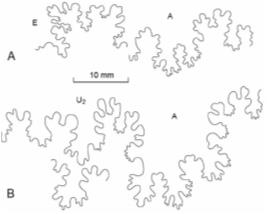
Then the upper flanks become more convergent, and the bullae blunter and elongated into commas. The ribs become sigmoid, denser, and thinner. The clavi are inclined towards the siphon, at 35°. Under magnification, the first lateral lobe L1 is slightly taller than wide, with a square trunk and three short, thick branches.
A flat ammonite with whorls two-thirds covered and its body chamber over 200°. The umbilicus has a straight wall at 50°. Its rounded edge bears 11 bullae, each giving a pair of ribs ending in a ventrolateral clavus. With a shorter intercalary between the pairs, there are 36 ribs.
At the beginning of last whorl, the section is compressed trapezoidal with slightly convergent flanks and a flat venter. The umbilical bullae are small and pointed, visible on the inner whorls. The ribs are concave, with a steeper posterior slope, and projected forward near venter. The clavi are almost parallel to the siphon and alternate on either side.
Then the upper flanks become more convergent, and the bullae blunter and elongated into commas. The ribs become sigmoid, denser, and thinner. The clavi are inclined towards the siphon, at 35°. Under magnification, the first lateral lobe L1 is slightly taller than wide, with a square trunk and three short, thick branches.
Remarks.
This species, known only from Mangyshlak, was recently revised by Kennedy & Walaszczik (2025, pp. 14–16, text-figs. 8–9 and pl. 3–6). They compare its suture line (right, B), also illustrated by Mikhailova (1980), to the lower suture line of Semenoviceras from the same level, specifically S. michalskii (A). CP-430 corresponds well to specimen E in their text-fig. 9 and to that in their pl. 6 fig. 2.
Jaffré's Semenovites michalskii (2023, pp. 109-110) does not have the falcate ribs of this species. With its more sigmoid ribs, it is probably an Anahoplites rossicus. We have added it to the table (specimen RJ-1650).