| Measurements | D mm | H/D | T/D | U/D | H/T |
|---|---|---|---|---|---|
| Neotype Spath | 31 | 0.51 | 0.26 | 0.16 | 1.96 |
| CP-575 | 49.3 | 0.49 | 0.29 | 0.19 | 1.72 |
| LFS 2191 Spath | 50 | 0.52 | 0.28 | 0.15 | 1.86 |
| Age | Origin |
|---|---|
|
Grey clay A. intermedius zone Middle Albian |
Temple Lake Aube France |
| Measurements | D mm | H/D | T/D | U/D | H/T |
|---|---|---|---|---|---|
| Neotype Spath | 31 | 0.51 | 0.26 | 0.16 | 1.96 |
| CP-575 | 49.3 | 0.49 | 0.29 | 0.19 | 1.72 |
| LFS 2191 Spath | 50 | 0.52 | 0.28 | 0.15 | 1.86 |
| Age | Origin |
|---|---|
|
Grey clay A. intermedius zone Middle Albian |
Temple Lake Aube France |
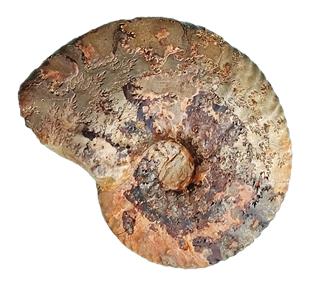
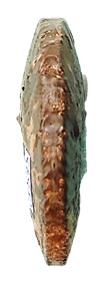
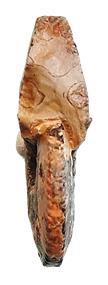
Description. Pyritic phragmocone with visible sutures, discoid, very compressed and involute, with whorls covered to 65% which rise rapidly. Very high trapezoidal whorl section, with sides initially convex then flat, converging towards a narrow and flat venter with angular shoulders. The maximum thickness is reached at the lower quarter of the flanks. The top of the section is slightly pinched, to the point of making the sides a little concave near venter. Small umbilicus with a low, slightly rounded wall, sloping at 70%, the edge of which bears 15 small proverse bullae, comma-shaped.
Each bulla gives a weak, slightly sickle-shaped rib, discernible only at the top of the flanks, followed by 3-4 shorter intermediate ribs. All ribs end in small clavi on the ventral edges which are thus finely notched. These clavi form an angle of 60° with the siphon and are alternate on either side. The number of clavi is difficult to count because some are erased, but there are at least 50. The first lateral lobe L1 is broad, shallow, with three barely diverging branches. Unlike the late forms of the species, the ventral lobe L is here well centered on the siphonal line.
Remarks. Personal discovery. This common species is often confused with other Anahoplites, in particular some specimens can have fine ribs visible over the entire height of the sides and thus resemble A. intermedius. But it is easily distinguished by its involution (O/D = 0.14-0.22), its weak or erased ribs on the sides, and its higher whorls, with more convergent and flatter flanks. The section is often a little pinched near venter, as on our ammonite. In the Anglo-Paris Basin, it is found from the intermedius zone to the pricei zone.