| Measurements | D mm | H/D | T/D | U/D | H/T |
|---|---|---|---|---|---|
| CP-458* | 57.2 | 0.47 | 0.23 | 0.23 | 2.08 |
| LFS193 Spath | 68 | 0.41 | 0.25 | 0.26 | 1.64 |
| LFS336 Spath | 68 | 0.43 | -- | 0.21 | -- |
| Age | Origin |
|---|---|
|
Grey clay A. intermedius zone Middle Albian |
Lac du Temple Aube France |
| Measurements | D mm | H/D | T/D | U/D | H/T |
|---|---|---|---|---|---|
| CP-458* | 57.2 | 0.47 | 0.23 | 0.23 | 2.08 |
| LFS193 Spath | 68 | 0.41 | 0.25 | 0.26 | 1.64 |
| LFS336 Spath | 68 | 0.43 | -- | 0.21 | -- |
| Age | Origin |
|---|---|
|
Grey clay A. intermedius zone Middle Albian |
Lac du Temple Aube France |
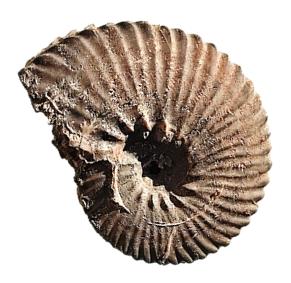
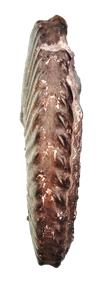
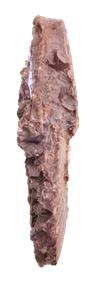
Description. Pyritic, septate internal mold with visible sutures and a corroded, unfigured side. Compressed whorls, 60% covered, with a high trapezoidal cross-section and barely convex flanks. Low umbilicus sloping at 70°, its edge bearing 18 small, proverse, and prominent, comma-shaped bullae. Each bulla gives rise to an average of two thin ribs, rather arched at the beginning of last whorl, then slightly flexuous. A shorter intercalary rib is generally observed between two consecutive pairs of ribs. Two lautiform pairs are visible at 2 and 3 o'clock on the profile view. There are a total of 46 closely spaced ribs, each terminating in a small, low clavus on the angular ventrolateral shoulder. The clavi of the two sides are separated by a flat, smooth ventral band. They alternate on either side of the siphonal line and form a 60° angle with it.
Remarks. Personal discovery. An uncommon species, similar in profile view to a Hoplites dentatus var. densicostatus. It differs from the latter by its lack on ventral sulcus. It also resembles Anahoplites intermedius, but more compressed and with more numerous and finer ribs, see Spath, 1925, pl. XII, figs. 5-6. For Amédro et al. (2014), it would be a variant of A. intermedius. Hence, the latter would include, from least ornamented to most ornamented, A. mantelli Spath, 1925, A. intermedius Spath, 1925, and A. praecox Spath, 1925. In addition, there is a comparable form with a broad umbilicus, A. evolutus Spath, 1925 (text-fig. 37 p. 134). Our specimen is distinguished by its very slightly curved ribs.