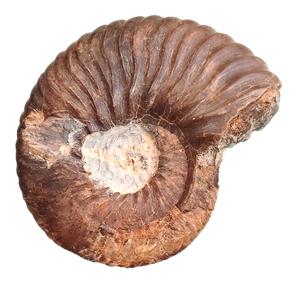
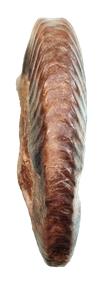
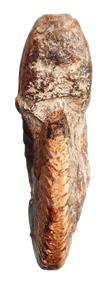
| Measurements | D mm | H/D | T/D | O/D | H/T |
|---|---|---|---|---|---|
| CP-154 | 77.5 | 0.40 | 0.27 | 0.32 | 1.45 |
| Holotype | 93 | 0.40 | 0.20 | 0.30 | 2.00 |
| Age | Origin |
|---|---|
|
Bed F (sandy limestone) A. intermedius zone Middle Albian |
Courcelles quarry Commune of Clérey Aube, France |
| Measurements | D mm | H/D | T/D | O/D | H/T |
|---|---|---|---|---|---|
| CP-154 | 77.5 | 0.40 | 0.27 | 0.32 | 1.45 |
| Holotype | 93 | 0.40 | 0.20 | 0.30 | 2.00 |
| Age | Origin |
|---|---|
|
Bed F (sandy limestone) A. intermedius zone Middle Albian |
Courcelles quarry Commune of Clérey Aube, France |
Description. A slightly evolute, calcareous internal shell with a brown test, half-ovelapping whorls, one unprepared side and the beginning of the body chamber on the last 120°. The inner whorls are not preserved in the umbilicus. The beginning of the last whorl has a tall trapezoidal section, a flat venter, small comma-shaped umbilical bullae, minute ventrolateral clavi, and weak sigmoid ribs on the flanks. Then, just before the body chamber, the whorl section thickens and becomes more convex near the venter. The umbilical bullae elongate and rise, giving rise to more prominent rib pairs with a distinctly steeper posterior slope. One rib of each pair often separates from its bulla to form a shorter intercalary. Due to damaged areas, one counts twenty bullae and fifty clavi approximately. The umbilicus gradually opens and the slope of its wall increases.
Remarks. Identification by Francis Amédro. According to him (1992), this species is a variant with more distinct ribs of Anahoplites osmingtonensis, which is almost smooth (see its entry). As with our specimen, Owen's holotype (1971, pl. 1, fig. 2a-b) has ribs that are mainly visible on the body chamber. According to the table, it is more compressed than our CP-154, but Owen writes that it is somewhat crushed. Amédro et al. (2014, pl. 33) illustrate three A. osmingtonensis specimens from Aube. The one with stronger ribs in fig. 3 corresponds to the grimsdalei variant and is quite similar to our specimen. Owen places A. grimsdalei and osmingtonensis at the top of the dentatus zone, but in Aube, these two species appear at the same time as A. intermedius, which defines the next zone.