Created 2023/03/19
Updated 2025/06/09
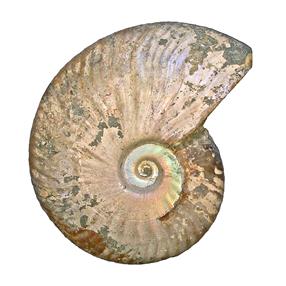
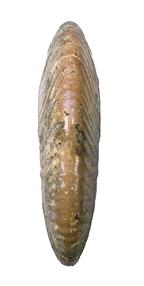
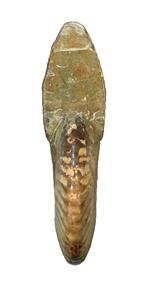
Aioloceras tenuicostulatum (Collignon, 1963)
| Measurements |
D mm | H/D | T/D | U/D | H/T | Ribs |
|---|
| CP-20 |
48 | 0.50 | 0.31 | 0.19 | 1.60 | 42 |
| Holotype |
79 | 0.49 | 0.29 | 0.19 | 1.69 | 45 |
| CP-141 |
102 | 0.49 | 0.26 | 0.17 | 1.86 | 61 |
| R. Touch |
102.5 | 0.51 | 0.26 | 0.18 | 1.96 | 59 |
| CP-646 |
123.4 | 0.48 | 0.26 | 0.19 | 1.87 | 58 |
| CP-338 figured |
243 | 0.43 | 0.21 | 0.25 | 2.03 | 72 |
| Age |
Origin |
|---|
A. besairiei zone
Lower Albian
|
Ambatolafia, Boeny Region
Madagascar
|
Description.
Discoid ammonite with its test, preserved in a glauconitic green sandstone and completely septate, with whorls overlapping by 60%. The trace of the umbilical suture of the missing part of the coil is visible on the last whorl. This shows that the whorl overlap then drops to 50%. Suture lines are invisible. The flanks of the very high, lanceolate section diverge slightly up to mid-height, then converge towards a narrow, arched venter. The small umbilicus has a straight wall sloping at 80° and a narrowly rounded margin.
Thin, closely spaced ribs, very low and rounded, begin gradually at some distance from umbilicus. They have a straight, proverse portion, followed midway along the flank by a concave arc, giving them a sickle-like appearance. Shorter ribs originate in the upper half of the flanks. Eight slightly stronger ribs widen up to mid-flank and then narrow again; they are preceded and followed by a minute constriction, visible under tangent light as a slightly deeper intercostal space. In total, 61 ribs of identical shape cross the venter, on which they lower and form a proverse sinus.
Remarks.
A species close to Aioloceras besairiei, but with a higher whorl section and more numerous ribs that persist longer: around sixty at 10 cm in diameter, compared to 40-45 for besairiei of this size, whose ribs may already be more attenuated. Our CP-646 has a more rhythmic ornamentation, with fairly strong ribs separated by 4-6 finer ones. According to Riccardi & Medina (2002) and Kennedy & Klinger (2014), A. besairiei and A. tenuicostatum may be synonyms. Without explanation, the latter two authors call it tenuicostatum: a typographical error, or a deliberate correction of the Latin?