Created 2023/03/13
Updated 2023/08/12
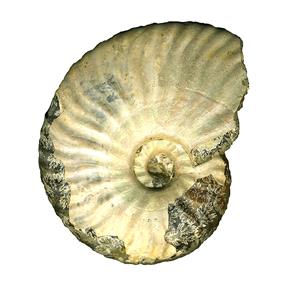
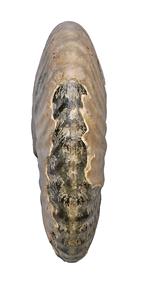
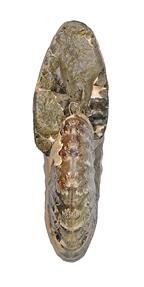
Aioloceras besairiei (Collignon, 1949) – Young macroconch
| Measurements |
D mm | H/D | T/D | U/D | H/T | Ribs |
|---|
| CP-22 |
52 | 0.50 | 0.32 | 0.17 | 1.58 | 34 |
| Holotype (m) |
68 | 0.48 | 0.28 | 0.19 | 1.73 | 40 |
| CP-10 (M) |
75 | 0.49 | 0.31 | 0.20 | 1.61 | 40 |
| CP-124 (M) |
101 | 0.49 | 0.30 | 0.19 | 1.63 | smooth |
| CP-140 (M) |
155 | 0.46 | 0.26 | 0.22 | 1.76 | 45 |
| Age |
Origin |
|---|
A. besairiei
Malagasy zone
Lower Albian
|
Ambatolafia
Boeny Region
Madagascar
|
Description.
Phragmocone with test and whorls 65% covered. The flanks of the ogival section diverge slightly up to the inner third, then converge towards a narrow, arched venter. The small umbilicus has a straight wall sloping at 80° and a narrowly rounded margin. The ribs arise from the umbilical margin on the inner whorls. On the last whorl, low, rounded primary ribs arise a little further from the umbilicus, without tubercles. They are proverse and straight, then divide at mid-flank into two concave secondary ribs.
The bifurcations occur at varying heights, and secondary ribs detach from their primary rib here and there. There are 40 similar ribs on the ventral side, which they cross with an attenuation and a rounded proverse sinus. The rib bifurcation points rise to the external third of the flank on last half-whorl. Some ribs are a bit stronger than the others, and a few weak constrictions take the form of slightly wider and deeper intercostal spaces (at 2, 5, and 10 o'clock on the lateral view).
Remarks.
This index-ammonite is the most frequent in Ambatolafia. It is most commonly found in fossil exhibitions and on the Internet, under the obsolete name Cleoniceras besairiei. The specimen CP10 consists of the inner whorls of a macroconch. Indeed, it lacks a body chamber at 75 mm, whereas complete microconchs have a diameter between 50 and 70 mm, according to Kennedy & Klinger (2012). Collignon's holotype is a microconch, with less convergent flanks and a wider venter. The ribs vanish on larger specimens, which can reach 24 cm (see the entry for the adult macroconch). This attenuation can occur at varying diameters. The numerous specimens illustrated in Riccardi & Medina (2002) and Kennedy & Klinger (2012) underline the variability of this species.